Where Your Cooling Dollars Go: A Florida AC Energy Bill Breakdown
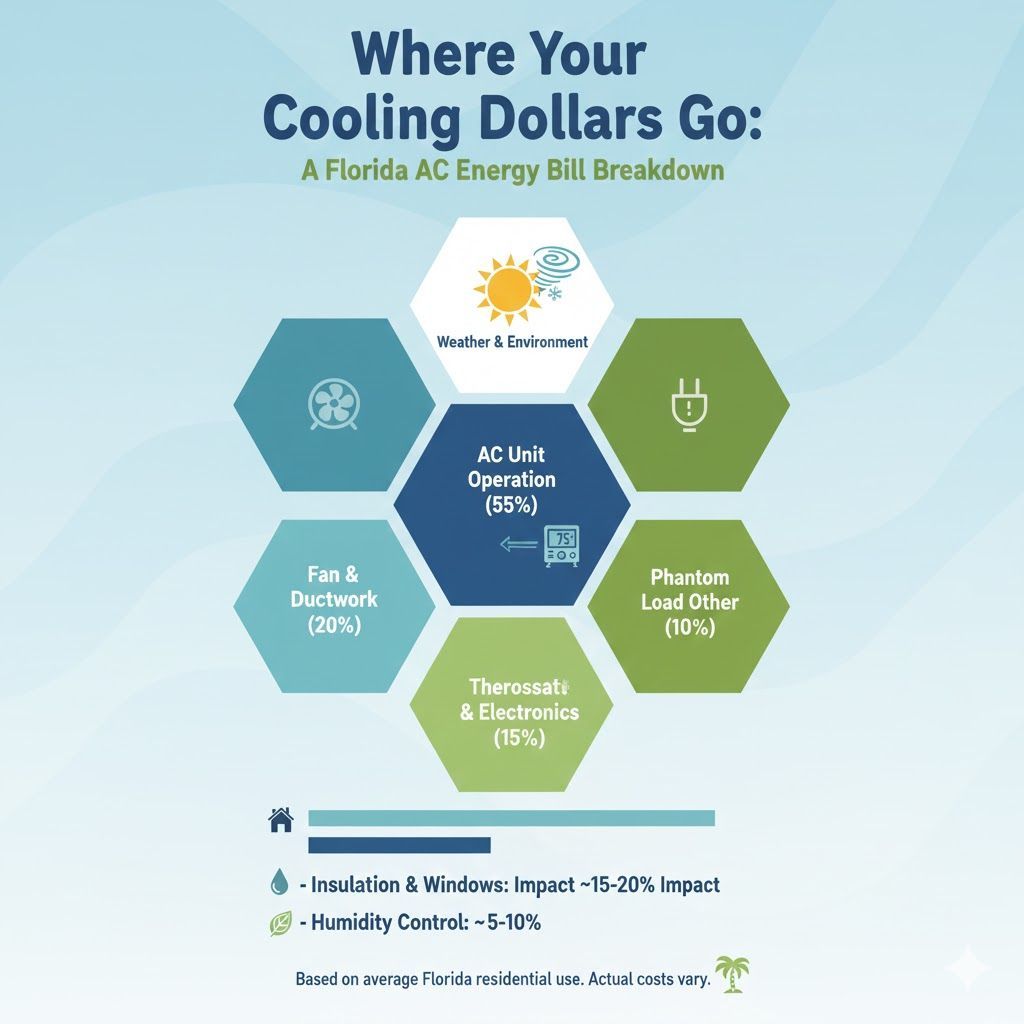
In Florida, air conditioning usually takes the biggest slice of a home’s electric bill because it runs more often and works harder in the heat and humidity. In many Florida homes, cooling alone can account for roughly 40–50% of total household electricity use, making it the number one target for cutting costs.
Florida’s humid climate forces an air conditioner to remove moisture as well as heat, so it stays on longer than in drier states and uses more kilowatt‑hours (kWh). In southern parts of the state, AC use can be nearly year‑round, so even small inefficiencies add up quickly on monthly utility bills.
Typical Florida Home Energy Breakdown
Think of your monthly electric bill as a pie where cooling is usually the largest slice. In a typical Florida home, AC usage often lands around 40–50% of total electricity, especially in warm months. Other big contributors include water heating, refrigerators, laundry, lighting, and electronics, which share the remaining half of the bill.
For a mid‑size Florida home using around 1,500–2,500 kWh per month, that can mean hundreds of kWh dedicated only to air conditioning. When the AC is older or poorly maintained, it may slide toward the higher end of that range, raising your bills without delivering better comfort.
How AC Uses Electricity
Your central AC uses electricity to power both the outdoor unit (compressor and condenser fan) and the indoor air handler (blower), and together they can draw several thousand watts while running. For example, one estimate for an average central AC is about 3,500–4,300 watts when it is actively cooling, which adds up quickly when it cycles on and off all day.
Utility companies bill in kilowatt‑hours, so if a 3,500‑watt system runs for eight hours in a day, it can easily use 25–30 kWh just for cooling. Multiply that by a month of hot, humid weather and it is easy to see why AC can dominate your summer electric bill.
Florida’s Heat and Humidity Effect
Florida’s “wet blanket” humidity means your AC is not just cooling the air; it is also wringing out moisture, which takes extra energy. On a hot and humid day, a significant portion of your cooling load can be used simply to dehumidify your home before the temperature even drops to where you want it.
Because there are many warm days even in the so‑called cooler seasons, AC runtime can stretch across 10–12 months of the year in much of Florida. That extended operating season increases both energy use and wear and tear, making maintenance and efficiency upgrades more important.
Thermostat Settings and Cost
Thermostat choices have a big impact on how much your AC costs to run. In Florida, dropping the thermostat even a few degrees below recommended settings can noticeably increase cooling expenses. Guidance from Florida energy experts notes that for every degree you set the thermostat below about 78°F, you might spend up to around 8% more on cooling costs.
That means keeping your home at 72°F instead of 78°F could add a significant percentage to your monthly bill, especially during long heat waves. Using programmable or smart thermostats to raise the temperature when you are away and cool more when you are home helps shrink AC runtime without sacrificing comfort.
Equipment Efficiency (SEER) and Age
Your system’s Seasonal Energy Efficiency Ratio (SEER) tells you how much cooling you get per unit of electricity used. Florida now requires newer systems to meet higher minimum SEER standards, such as 15 SEER, and upgrading from an older, low‑SEER unit can significantly cut cooling costs.
In some cases, moving from a worn‑out older system to a modern high‑efficiency unit can reduce AC energy use by up to about 40%, depending on the starting efficiency. That kind of improvement can shift a large share of your monthly bill back into your pocket over the life of the equipment.
Runtime, Sizing, and Ductwork
How long your AC runs each day depends on outdoor temperature, humidity, home insulation, and system sizing. An undersized unit may run nearly constantly and still struggle to keep up, while an oversized unit may short‑cycle, turning on and off frequently and failing to dehumidify properly.
Duct leaks, poor airflow, and hot attics can also waste cooling power, forcing the system to run longer to deliver the same indoor temperature. Fixing duct issues and improving attic insulation can reduce the load on your AC so each hour of operation provides more comfort for less energy.
Practical Ways to Lower AC’s Share
Several practical steps can reduce how much of your bill goes to cooling without sacrificing comfort. Raising the thermostat slightly, using ceiling fans to improve perceived comfort, and closing blinds during peak sun all help your system cycle off more often.
Regular maintenance—such as annual tune‑ups, coil cleaning, and filter replacement—keeps efficiency high, while sealing air leaks and improving insulation lowers the cooling load. Over time, combining these changes with a higher‑SEER system and smart thermostat can significantly shrink the portion of your energy bill dominated by AC.