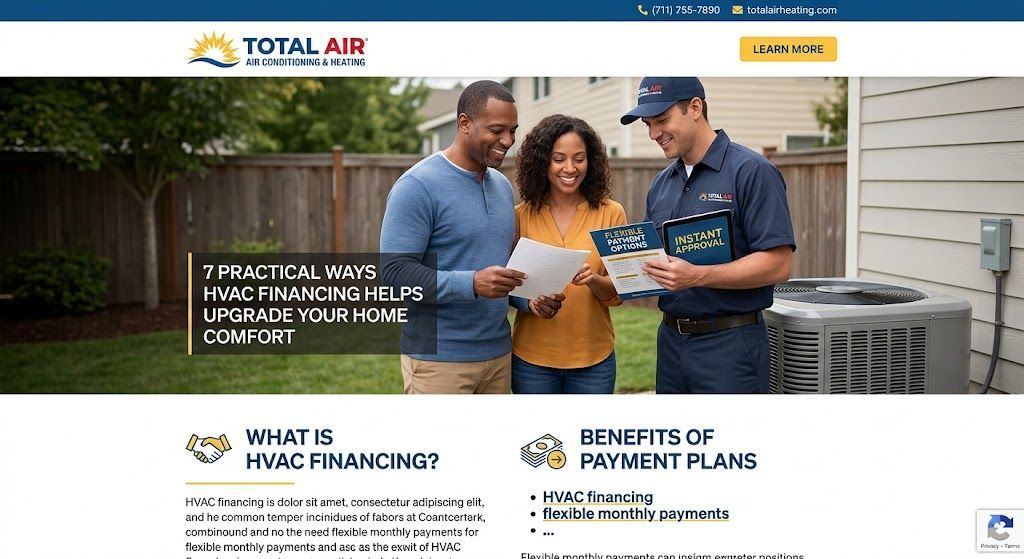
7 Practical Ways HVAC Financing Helps Upgrade Your Home Comfort
Replacing an aging heating or cooling unit is one of the most critical maintenance steps a property owner can take. However, a full heating, ventilation, and air conditioning replacement often represents a substantial capital expenditure. When a system breaks down unexpectedly during extreme summer humidity or a sudden winter freeze, coming up with full upfront cash right away isn't always feasible or practical.
Fortunately, modern financial solutions make upgrading your home climate controls simpler and far less stressful. By utilizing flexible funding structures, homeowners can secure high-efficiency equipment immediately while spreading the overall installation costs into manageable monthly installments.
If you are exploring ways to modernize your home heating and cooling, this complete guide breaks down how modern funding arrangements work, how to prepare your application, and how to choose the right payment plan for your household budget.
What Is HVAC Financing and How Does It Work?
HVAC financing is a specialized credit program or unsecured loan arrangement designed specifically for residential and commercial heating and cooling installations, retrofits, and major system repairs. Instead of paying thousands of dollars in a single lump sum, property owners partner with qualified climate service providers and lending institutions to distribute costs across fixed timeframes.
The Mechanics of System Loans
When you apply for funding, the lender evaluates factors such as credit score, debt-to-income ratio, and income history. Upon approval, the finance company covers the upfront equipment and installation expenses directly with your service contractor.
You then make recurring monthly payments to the financing provider over a set term—ranging anywhere from 12 months up to several years, depending on the terms you select.
Key features often include:
- Fast Pre-Approval: Quick online applications provide instant conditional approvals without long waiting periods.
- Fixed Monthly Payments: Standard structured payment schedules keep your home budgeting predictable.
- Flexible Term Options: Short-term promotional plans (such as interest-waived options) or extended multi-year payment terms.
- No Collateral Required: Most consumer climate system programs are unsecured loans, meaning you do not have to put your property up as security.
7 Major Benefits of Financing Your Climate System Upgrade
Understanding why so many property owners opt for payment plans over lump-sum cash payments helps clarify if this approach aligns with your long-term financial strategy.
1. Preserves Your Cash Flow and Emergency Savings
Emergencies happen when you least expect them. Liquidating your liquid savings or emergency funds to purchase a high-capacity heat pump or central air unit leaves you vulnerable to other unexpected expenses. Financing keeps your hard-earned cash intact for medical needs, routine living expenses, or home equity growth.
2. Enables Immediate Replacement in Urgent Situations
A broken air handler or fried compressor during peak summer weather is more than a mild inconvenience—it poses severe indoor air quality and temperature safety hazards. Secured credit lines eliminate delays, allowing certified technicians to replace broken infrastructure immediately.
3. Grants Access to Higher-Efficiency Equipment
High-efficiency systems with high SEER2 (Seasonal Energy Efficiency Ratio 2) ratings, variable-speed compressors, and smart thermostat integrations carry higher upfront price tags. Spreading out payments makes top-tier units surprisingly accessible. Higher-rated systems consume less electricity, lowering monthly utility bills to help offset your regular monthly payment.
4. Offers Promotional Interest-Waived Programs
Many lending networks offer promotional windows—such as 6, 12, or 18 months—where interest is waived if the total balance is paid in full before the promotional period expires. If managed properly, this operates similarly to an interest-free loan, allowing you to pay for equipment over time without incurring extra borrowing costs.
5. Streamlines Unexpected Repair Costs
Financing isn't restricted exclusively to entire system teardowns and installations. Major structural repairs, ductwork overhauls, commercial compressor replacements, and indoor air purification retrofits often qualify under the same funding programs.
6. Protects Against Inflationary Costs
HVAC manufacturing costs and shipping rates continue to rise over time. Delaying a system replacement for two or three years while saving up cash often means paying significantly higher equipment prices later. Securing today's equipment costs with locked-in financing fixes your purchase price immediately.
7. Builds Credit History
Consistently making on-time monthly installments toward a structured consumer loan positively contributes to your personal payment history, which plays a major role in calculating your overall credit score.
Step-by-Step Guide to Applying for Equipment Financing
Securing approval for a new unit installation is straightforward if you know what steps to follow. Below is a step-by-step roadmap to guide you through the process.
Step 1: Conduct a Comprehensive Home Comfort Assessment
Before filling out loan applications, schedule an inspection with a licensed technician. They will conduct heat-load calculations (Manual J calculations) to determine the exact sizing and capacity requirements for your property.
Step 2: Compare System Options and Quotes
Ask your installer to provide transparent estimates featuring standard, mid-grade, and high-efficiency options. Reviewing these tier levels side-by-side allows you to compare monthly payment breakdowns rather than focusing solely on overall sticker prices.
Step 3: Review Available Rebates and Tax Incentives
Check if the equipment qualifies for regional utility company rebates or federal tax credits (such as Energy Star inflation reduction incentives). Combining government rebates with local utility incentives significantly reduces your baseline loan principle before you even finalize terms.
Step 4: Gather Necessary Documentation
Lenders generally require standard identification and income verification, including:
- Government-issued photo identification (Driver's License or Passport)
- Proof of property ownership
- Recent pay stubs or proof of income
- Contact details and social security number for credit check authorization
Step 5: Submit the Online Application
Most modern lending portals allow you to apply digitally via a smartphone or laptop. Online applications usually take only a few minutes to complete and provide instantaneous approval status updates.
Step 6: Select Your Preferred Payment Schedule
Once approved, choose the payment structure that fits your monthly budget best. Review loan APRs, promotional conditions, repayment durations, and early payoff clause details before signing final agreements.
Key Terms to Look for in Financing Agreements
When evaluating any funding contract, ensure you read the fine print and understand these essential terms:
- Annual Percentage Rate (APR): The annual rate charged for borrowing, represented as a percentage.
- Promotional Period: A set timeframe during which special terms (like deferred interest or zero-percent APR) apply.
- Deferred Interest vs. 0% APR: With 0% APR, no interest accrues during the promo period. With deferred interest, interest builds quietly in the background; if the balance isn't paid off before the term ends, all accrued interest is retroactively added to your bill.
- Prepayment Penalties: Extra fees charged if you pay off the balance ahead of schedule. (Opt for plans with zero prepayment penalties).
- Fixed vs. Variable Rate: Fixed rates maintain the same interest percentage for the entire loan life, while variable rates fluctuate based on broader economic indexes.
How Smart Financing Pairs with System Energy Savings
One overlooked strategy when replacing an old heating and air conditioning unit is calculating net operational savings.
System efficiency is measured by SEER2 ratings. Older units operating at 10 SEER consume drastically more electricity than modern 16 to 20+ SEER2 systems. Replacing a decades-old climate system often slashes monthly electric bills by 20% to 40%.
For example, if a modern heat pump saves you $75 every month on electricity, and your loan payment is $120 per month, the net out-of-pocket cost for your brand-new system is effectively only $45 per month. Factory warranties and service guarantees also eliminate unexpected out-of-pocket repair costs for years to come.
Finding the Right Partner for Your Home Investment
Upgrading your home comfort infrastructure should always be a smooth, stress-free process. Partnering with a trusted contractor who provides flexible payment options makes taking care of your family's home environment straightforward and affordable.
Whether you need urgent emergency air conditioning repairs or are planning a complete energy-efficient HVAC replacement, flexible HVAC financing options allow you to get the quality service you need today while keeping your long-term budget perfectly intact.
Taking time to explore your funding choices, leverage available energy rebates, and select reliable equipment guarantees high indoor air quality and total climate peace of mind for years to come.