Commercial HVAC Installation: Ultimate Business Guide
Maintaining a comfortable, healthy, and energy-efficient environment inside a commercial building is fundamental to running a successful enterprise. Whether you manage a busy retail storefront, a sprawling corporate office, a restaurant, or an industrial facility, your heating, ventilation, and air conditioning system works continuously behind the scenes. It keeps employees productive, customers relaxed, and sensitive equipment operating within safe thermal ranges.
However, commercial climate control systems do not last forever. When an existing unit reaches the end of its useful lifespan—or when a new building project requires a custom setup—making informed choices about system design, sizing, and contractor selection becomes crucial. Investing in a modern, high-efficiency system delivers substantial long-term returns in reduced energy bills, fewer operational interruptions, and improved indoor air quality.
How Commercial HVAC Systems Differ from Residential Units
While both residential and commercial climate control equipment share the basic scientific principles of thermodynamics and refrigeration, their design and engineering are completely different. Understanding these differences highlights why commercial projects require specialized expertise.
Scale and Thermal Loads
Commercial buildings are significantly larger and feature dynamic internal heat loads. Computers, heavy equipment, large lighting grids, high-density occupancy, and continuous foot traffic generate substantial internal heat. A commercial system must actively balance these shifting internal loads alongside external weather conditions.
Modular and Rooftop Configurations
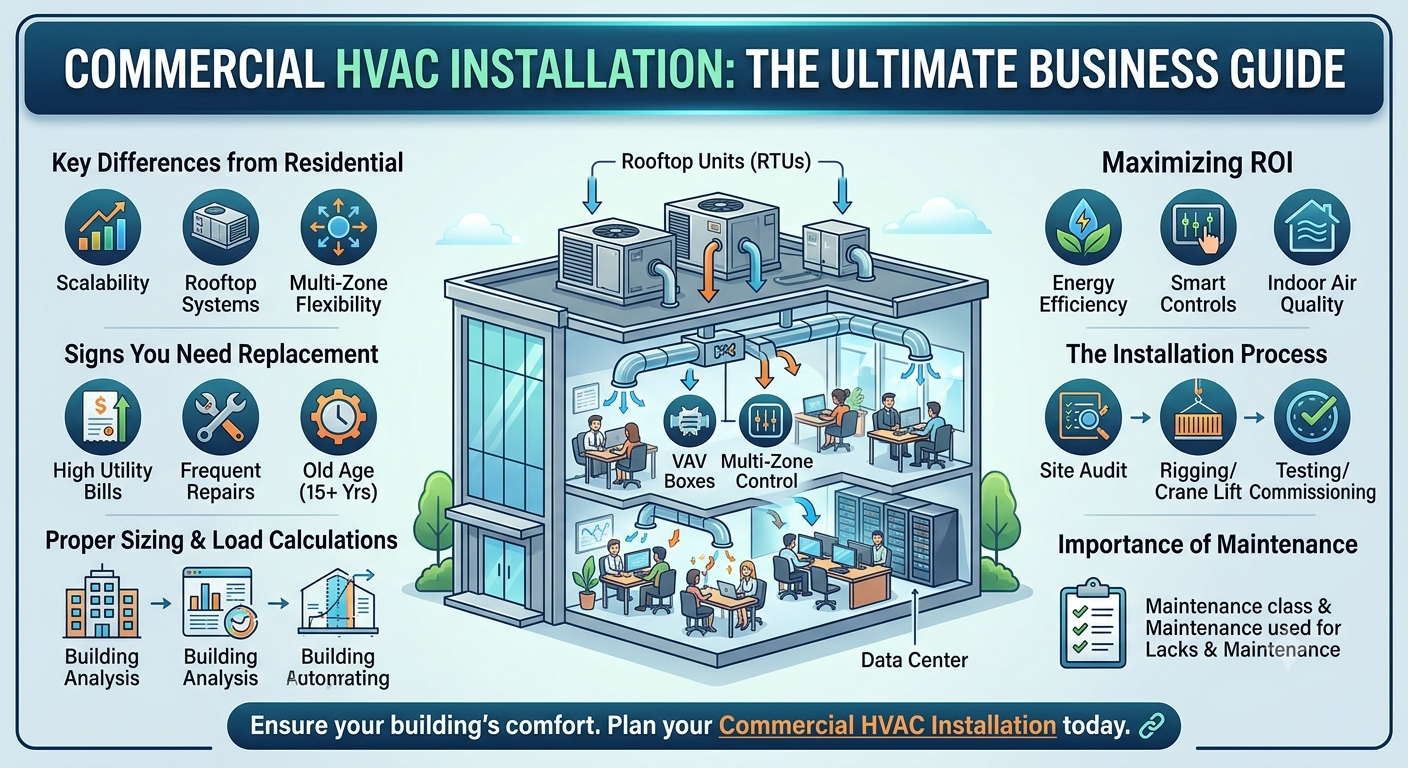
Unlike residential setups that typically use a single split system with indoor and outdoor units, commercial facilities frequently rely on packaged rooftop units (RTUs), chillers, variable refrigerant flow (VRF) systems, or multi-zone split systems. Rooftop placements save valuable ground-level square footage and reduce indoor noise while simplifying maintenance access for technicians without disturbing day-to-day business operations.
Multi-Zone Flexibility
A commercial building often houses diverse spaces with vastly different climate requirements under one roof. For example, a conference room packed with twenty people requires far more cooling capacity than a quiet executive corner office, while a server room demands continuous low temperatures 24 hours a day. Commercial systems utilize complex damper networks, variable air volume (VAV) boxes, and smart thermostats to deliver tailored zonal comfort.
Clear Signs Your Commercial System Needs Replacement
Recognizing when your commercial equipment is approaching failure allows you to plan a replacement strategically rather than facing an unexpected total shutdown during peak weather.
- Rapidly Escalating Utility Bills: If your energy costs are creeping upward without a corresponding increase in utility rates or business operational hours, your system is likely losing efficiency due to worn compressors, leaking ductwork, or degraded heat exchangers.
- Frequent and Expensive Service Calls: When repair costs begin rivaling the amortized value of new equipment, continuing to patch an old unit becomes financially unviable.
- Persistent Temperature Imbalances: Drafty rooms, hot spots, or rooms that feel continuously humid signal that your current equipment can no longer manage airflow or humidity removal effectively.
- System Age Exceeding 15 to 20 Years: Commercial units operating in demanding climates undergo thousands of hours of runtime each year. Beyond the 15-year mark, crucial components suffer mechanical fatigue, and older systems rely on outdated refrigerants that are phased out or expensive to source.
- Unusual Noises or Persistent Odors: Grinding metal, loud rattling, or persistent musty smells indicate failing bearings, loose blower belts, or moisture accumulation inside ductwork.
The Critical Importance of Proper Sizing and Load Calculations
One of the most common mistakes made during commercial building upgrades is installing equipment based solely on the tonnage of the previous unit. Over time, buildings undergo modifications—such as upgraded insulation, energy-efficient windows, altered interior layouts, or changes in occupant density—that significantly alter heating and cooling requirements.
Professional technicians perform detailed commercial load calculations (often following Manual N procedures) rather than relying on quick rule-of-thumb estimates.
The Dangers of Oversized Systems
It might seem logical to purchase the largest unit available to guarantee cooling power, but oversizing creates severe operational problems. An oversized unit cools the space too quickly and shuts off before completing a full dehumidification cycle. This results in "short-cycling," which leaves indoor air feeling clammy and sticky while subjecting electrical components to severe start-stop wear, drastically shortening the unit's lifespan.
The Risks of Undersized Systems
Conversely, an undersized system will run continuously without ever reaching the target temperature on hot or cold days. This continuous strain drives energy bills through the roof, causes premature motor failure, and leaves occupants uncomfortable.
Accurate Load Calculation Variables
To determine exact tonnage and airflow requirements, qualified commercial specialists evaluate several key factors:
- Total building square footage and ceiling height.
- Orientation toward the sun and shading conditions.
- Insulation R-values in walls, ceilings, and roofs.
- Window square footage, glazing types, and solar heat gain coefficients.
- Number of daily occupants and peak traffic hours.
- Heat output from lighting, computers, servers, and appliances.
Maximizing ROI with Energy Efficiency and Modern Technology
Upgrading an outdated commercial heating and cooling setup represents a significant capital expenditure, but modern high-efficiency technology provides a clear return on investment (ROI).
High Efficiency Ratings
Modern equipment features higher Integrated Energy Efficiency Ratio (IEER) and Seasonal Energy Efficiency Ratio 2 (SEER2) ratings. Variable-speed compressors and direct-drive blowers automatically adjust their output in real time to match the precise heating or cooling demand, consuming only the energy needed at any given moment rather than running at 100% capacity constantly.
Smart Building Automation and Control
Integrating your new installation with a modern Building Management System (BMS) or smart commercial thermostats offers unprecedented control. Facilities managers can schedule temperature setpoints based on business hours, monitor energy consumption patterns remotely, receive instant alerts for maintenance needs, and optimize ventilation rates automatically.
Enhanced Indoor Air Quality (IAQ)
Clean indoor air directly impacts employee attendance, focus, and overall well-being. Modern commercial installations integrate high-efficiency MERV filtration, ultraviolet (UV) germicidal lights, energy recovery ventilators (ERVs), and advanced humidity control systems. These features actively filter out dust, airborne pollen, volatile organic compounds (VOCs), and excess moisture, creating a healthier indoor workspace.
What to Expect During a Professional Installation Project
A seamless commercial replacement or new build installation relies on detailed planning, coordination, and technical precision.
- Comprehensive Site Audit and Engineering: Technicians inspect existing electrical capacity, structural roof supports, ductwork integrity, and drainage paths to design a complete system layout.
- System Selection and Customization: Choosing the ideal equipment package tailored to your facility's layout, budget, and sustainability goals.
- Phased Execution Plan: Establishing a timeline that minimizes disruption to daily business operations. This often includes scheduling heavy crane lifts or loud mechanical work during off-peak hours or weekends.
- Old Equipment Removal and Infrastructure Upgrades: Safely recovering old refrigerants according to EPA guidelines, removing obsolete equipment, adjusting roof curbs, and modifying electrical panels or gas lines as needed.
- Precision Fitting and Duct Integration: Installing new units, sealing duct transitions to prevent conditioned air leaks, and setting up condensate drain systems.
- System Commissioning and Testing: Verifying electrical loads, testing safety controls, balancing airflow across all supply and return vents, and calibrating digital controls.
Protecting Your Investment with Ongoing Maintenance
Once your new commercial equipment is up and running, protecting it with a structured preventative maintenance agreement ensures it operates at peak performance for decades. Regular professional inspections involve changing commercial air filters, cleaning evaporator and condenser coils, checking refrigerant charge levels, lubricating moving parts, tightening electrical connections, and clearing condensate drain lines.
Taking a proactive approach prevents minor issues from escalating into emergency breakdowns, maintains low monthly energy expenses, preserves manufacturer warranty coverage, and extends the operational lifespan of your infrastructure.
Partnering with Certified Commercial Experts
Selecting the right commercial HVAC partner is just as critical as selecting the right equipment. Commercial heating and cooling systems are complex, demanding high technical expertise, licensed professionals, and dedicated support to ensure every safety standard and building code is met without compromise.
When you are ready to enhance your facility's climate control, lower overhead expenses, and improve indoor air quality, scheduling a professional commercial HVAC installation with the experienced technicians at Total Air Inc. guarantees a tailored, energy-efficient solution engineered to keep your business running smoothly for years to come.
Final Thoughts for Business Owners
Upgrading your commercial climate control system is an investment in your building's long-term performance, comfort, and operational value. By choosing correctly sized, high-efficiency equipment and partnering with certified local installation professionals, you protect your bottom line against rising utility costs and unexpected mechanical downtime. A reliable commercial environment keeps your workforce comfortable and productive every single day.